The promise is tempting:
- Envision your dream app or game
- Write a detailed prompt
- Press Enter
- Answer any follow-up questions
- Buy Lambo
With the rise of Agentic AI, Vibe Coding has become a real term – the computer does the work while you sit back and do whatever…good vibes, right?
So – do you Vibe Code?
No. I actually enjoy solving problems and coming up with the systems for my game. When I find myself against a wall, part of the “fun” for me is finding a way around (or through) it! As a bonus, my abilities improve, so I’m able to design better systems and features for my game moving forward. For me, taking a shorcut like vibe coding an entire game would take all of the fun out of it.
The case for Vibe Coding
This should be pretty obvious: resources like time, energy, ability, and knowledge are serious constraints for us mere humans. AI claims to have a solution – a tireless agent who can “think” and “solve” problems in a creative and accurate way – generating hundreds of lines of code before you finish the first few sips of your morning coffee.
To a CEO or any executive, this is a lucrative idea. A dev can vibe code a new feature, debug and test the output, and ship the new feature before lunch. More features means more sales…
To an individual developer, having to once again type the boilerplate code for a loop, event, or game system you’ve coded a thousand times – having something else do that work for you sounds like a gift from Heaven above!
The catch…
Notive how I put “think” and “solve” in quotes? Picture a conversation with your sassy / sarcastic friend using the biggest “air quote” gesture possible…that was me as I typed that.
It’s not as “one & done” as they would like you to believe. The more complex the task or the bigger the ask, the more likely you’ll get a garbage response. Things that you assume are common knowledge aren’t assumtions the AI often makes, leaving out obvious (and crucial) concepts!
Not all AIs are created equal. There is a HUGE difference between each model’s variants. A relatively new thing in AI is something called “quantization,” which back in my MIDI music composition days was how you lined notes up mechanically on the beat. For an AI, quantization means a “dumber” AI – that uses less resources, and is often what is offerred on cheaper tiered plans or during peak hours to “small” customers.
AI Agents can’t actually think. They can analyze and choose the most probable path forward based on mathematical calculations. No matter what the marketing hype says, they also can’t come up with an original idea. Even the best AI is “trained” on existing code and documentation.
In English, Nerd!
The responses your AI gives you…and therefore the vibe coded app it returns…are just combinations of things that were created before. Like a remix or a new song that uses a loop or hook from an older, classic track. Can that still be good? Of course it can. But it can’t replace an original, creative concept.
Take Stardew Valley, for example…
Here we go again…you’re such a fanboy. UGH.
Whatever…anyway, ConcernedApe started out making a clone of the original Harvest Moon 2D games. If you take a look at some of the photos of his earliest versions, he sticks really close to the source material. This is what an AI agent will give you. If Ape had stopped there, he might have seen some success due to the genre never really appearing on PC, but the game would not have had the impact it did.
What made it stand out was the continual evolution of his concepts – characters evolved; gameplay concepts came and went; art styles changed. The game became something completely unique: and was a representation of the developer’s life experience. Every character, location, and event in the game has some real-world connection to Eric Barone.
Consistancy matters
Use the same prompt in two separate windows, and you’ll get two completely different responses – they’ll be stylistically different! One of the services I demoed for 2D to 3D conversion had a limited trial. I ran out of credits quickly, but wanted to try a few more things out to see if the tech was a good fit. I cheated a bit and created a second trial using my personal email. Of course, I created the PERFECT Elijah model on this account.
Sold, I signed up using my original business account…copied the prompt, used the same reference photos…but I couldn’t get Elijah’s model to look anything like the trial. Even when copying the randomly generated “seed” that allows the AI to simulate “randomness” didn’t help.
Imagine coming back to work on your project tomorrow after a great vibe coding session yesterday…except the agent you’re working with today is completely different. The code looks different…the “vibe” doesn’t match. (See what I did there?) 🙂
So what’s the point?
Vibe coding is a cool idea, but you still need inpiration, ideas, and skill. Vibe Coding a game will result in a mess of code and assets that you had no part in creating – and therefore no clue how anything was made! All that time you saved just shifted from creation to deciphering and editing. If there’s a bug, you’re stuck learning a codebase you’ve never seen before – or relying on today’s version of the agent to help you.
I don’t want to be stuck relying on a subscription to be able to work!
- If Anthropic goes bankrupt tomorrow, or decides to double the price of Claude – I can still write code because I know how to code.
- If my code has a problem, or a player finds a bug – I can fix it, because I know my codebase.
- If JetBrains discontinues Rider (my favorite IDE) – I can use another app (or a text editor!)
Devs still need to know how to code. Working with AI is inevitable – the tech is here to stay, and I’ll even admit to using it. I don’t vibe code, but like all other AI tools, I use AI as a partner. So here’s what I how I use AI coding agents:
Coding AI as a partner
As a programmer, there are a ton of libraries, APIs, and third party tools I use. Unity alone has multiple namespaces and a litany of commands, functions, and features. I can’t remember all the commands and reference material – especially when it might be days / weeks between uses of a particular concept. Instead of having a bunch of open tabs / bookmarks / notes, I will ask my AI for a friendly reminder. Here’s one I used today: I knew there was a shorter way to notate events without naming an explicit delegate – but I hadn’t typed it in a while. I asked Claude and got a quick refresher.
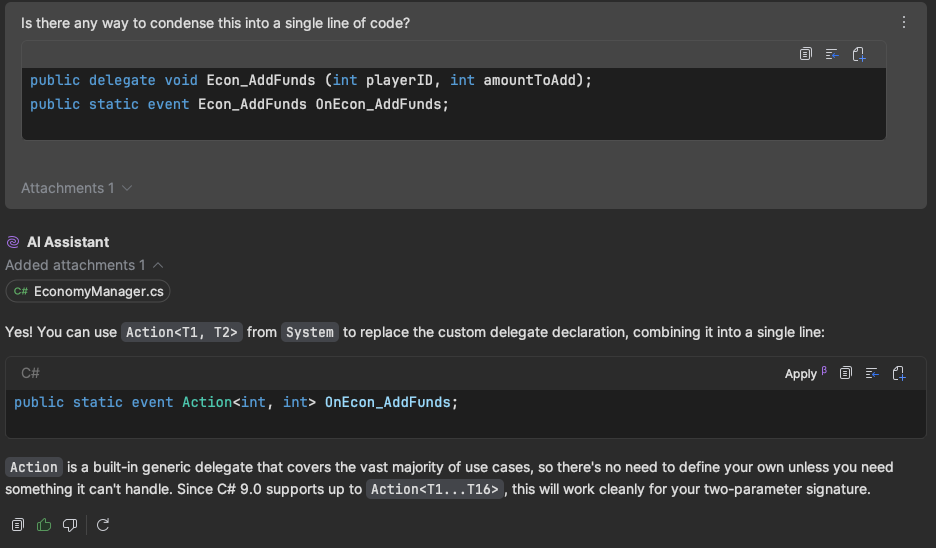
I’d completely forgotten about Action. My AI partner reminded me, saving me time spent searching. My JetBrains license comes with $10 in AI “Credits” each month – this answer cost me around $.04 – and yes, I was feeling too lazy to look it up myself. It seems petty, but I stay in the IDE – no web browser, no search, no potential distraction and recovery. Having that tool so tightly integrated is a masterstroke by the folks at JetBrains.
If I’m struggling to wrap my head around how to implement a feature, I’ll ask the AI how it would do it. Most of the time, the code it generates has issues and won’t work within the context of my game and its systems (though this context awareness is getting better each day!). I’ll typically design my own system, but the inspiration I get from seeing the AI’s implementation makes me think about the problem in a new way and allows me to come up with a solution.
If you haven’t tried it, I strongly recommend JetBrains AI. While they do have a vibe coding environment – I tried it once, and it just wasn’t for me. It burns through AI credits like there’s no tomorrow, and I just don’t want to spend more money on AI that I use only casually (I think the lowest my balance got was 4 during a very big sprint). Rather than searching StackOverflow or waiting for a response on Discord, chances are the AI can at least point you in the right direction.